Your Entryway Is Talking — Here's What It's Been Trying to Tell You
Think about the last time you walked through your front door after a long, grinding day. Maybe you kicked off your shoes and tripped over yesterday's sneakers. Maybe you dropped your bag on the floor because there was nowhere obvious to put it. Maybe you just... kept walking, barely registering the space at all.
Now imagine walking in and exhaling instead.
That's the difference a thoughtfully designed entryway can make — and it's a difference more Americans are starting to wake up to.
The Most Underestimated Space in Your Home
Bedrooms get all the cozy credit. Living rooms get the Pinterest boards. But the entryway? It's the first space your body occupies when you come home. It sets the emotional tone for everything that follows. And yet, in most American homes, it gets the leftover furniture, the mismatched hooks, and the pile of stuff that never quite found a real home.
Interior designers have a term for it: the decompression zone. It's the physical and psychological bridge between your outside life and your inside one. When that bridge is chaotic or cold, your nervous system doesn't get the signal that it's okay to relax. You carry the stress of the day a few steps further than you need to.
When it's warm, intentional, and welcoming? You start unwinding the moment the door swings open.
Real People, Real Transformations
Tamara, a teacher from Columbus, Ohio, described her old entryway as "basically a dumping ground." A folding chair that was never meant to stay, a coat rack overflowing with jackets from three seasons ago, and a floor mat that had seen better days. "I didn't realize how much it was affecting my mood until I changed it," she said. "Now I have a little bench, a basket for shoes, and a candle I light when I get home. It sounds small, but it genuinely changed how I feel walking in."
Dave, a remote worker from Austin, Texas, took a slightly different approach. Because he works from home, his entryway had started to feel like a non-space — somewhere he passed through a hundred times a day without noticing. He added a small gallery wall of family photos and a vintage console table he found at a local estate sale. "It made the whole apartment feel more intentional," he said. "Like, this is a place someone actually lives and cares about."
These aren't major renovations. They're small, deliberate investments in a space that pays dividends every single day.
What Your Entryway Actually Needs
Before you start shopping, it helps to think about what a good entryway is actually doing for you. At its core, it needs to solve three problems: storage, transition, and mood.
Storage means a place for the things that naturally land there — shoes, bags, keys, mail, dog leashes, umbrellas. If these things don't have a home, they become clutter, and clutter creates low-grade anxiety you might not even be consciously aware of.
Transition means a moment of pause. A bench where you can sit to take off your shoes. A hook where you can hang your coat and, symbolically, hang up the weight of the day too. That physical act of putting something down matters more than it sounds.
Mood is where the cozy comes in. A small lamp with warm-toned light. A plant that makes the space feel alive. A scent — whether from a candle, a diffuser, or even a simple linen spray — that your brain starts to associate with being home and safe.
Budget-Friendly Ways to Start Right Now
You don't need a designer or a gut renovation to make your entryway work harder for you. Here are some genuinely accessible starting points:
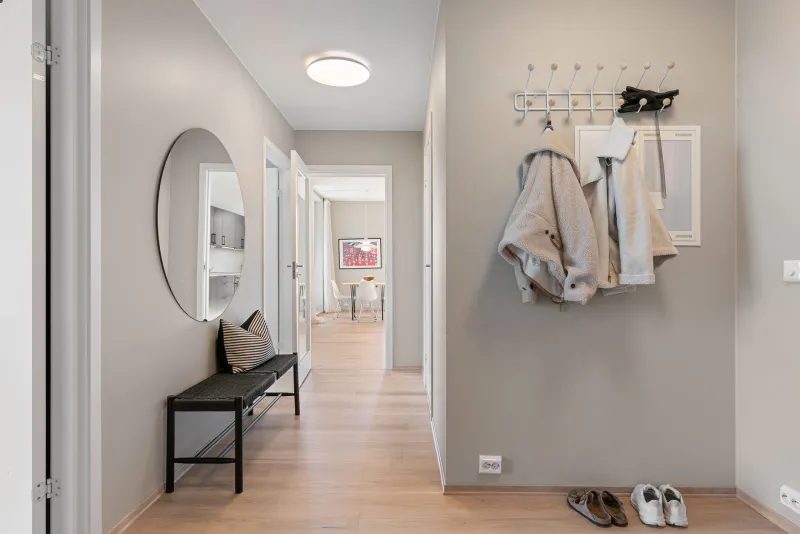
- Swap your overhead light bulb. Harsh, cool-toned lighting is the enemy of cozy. A warm-white LED bulb (look for 2700K color temperature) costs a few dollars and makes an immediate difference.
- Add a mirror. Beyond the practical benefit of a last-minute check before you head out, mirrors make small spaces feel bigger and brighter. Thrift stores are full of them.
- Invest in one good hook rail. Not the sad single hook behind the door — an actual mounted rail with three to five hooks. It keeps coats off the floor and gives the space a sense of order.
- Bring in something living. A potted plant, even a low-maintenance snake plant or pothos, signals life and warmth. It's hard to feel stressed in a space that has something growing in it.
- Use a tray for keys and everyday items. A simple ceramic or wooden tray corrals the chaos of daily pocket-emptying and makes the whole entry feel more curated.
The Scent Strategy
This one sounds a little out there, but bear with us. Scent is one of the most direct pathways to emotional memory and mood. The smell of your home is something you stop noticing over time — but guests notice it immediately, and more importantly, your brain still processes it even when you're not consciously aware of it.
A reed diffuser near the door, a small seasonal candle on a console table, or even a bowl of dried eucalyptus can create what designers sometimes call an "olfactory welcome." It's your home saying hey, you made it, you're safe, you can breathe now.
Think of It as an Investment, Not a Decoration
Here's the real shift in thinking: your entryway isn't a decorating project. It's a daily wellness investment. You pass through it every time you leave and every time you return. That's at minimum two interactions a day, every day, for as long as you live there.
Even a modest $100 to $200 spent thoughtfully — a bench from a discount furniture store, a few hooks, a plant, a lamp — spreads across hundreds of daily experiences. Per-use, it's one of the most cost-effective comfort upgrades in your entire home.
The bedroom gets the good pillows. The living room gets the throw blankets. Maybe it's time the entryway got a little of that same energy.
Because coming home should feel like something. And it can — starting about two feet past your front door.