When the Kitchen Gets Too Pretty to Cook In: How a Gorgeous Space Can Quietly Push Your Family Apart
The Kitchen That's Almost Too Nice to Use
There's a particular kind of kitchen that stops people in their tracks. The kind with a perfectly arranged spice rack, matching canisters lined up like little soldiers, and a countertop so spotless it practically glows. You've probably seen it on your Instagram feed. You might even have one.
And here's the thing — there's nothing wrong with wanting a beautiful kitchen. But somewhere between the styled herb garden on the windowsill and the carefully placed linen dish towels, something quietly shifts. The kitchen stops being a place where life happens and starts feeling more like a room you're trying not to disturb.
If your family has been gravitating toward takeout more often, or if the kids seem to vanish the moment someone suggests cooking together, your gorgeous kitchen might actually be part of the problem.
The Unspoken Rules of a Curated Space
Here's something most home design content won't tell you: spaces communicate expectations. When a room looks like it belongs in a magazine, the people who live with it start picking up on invisible rules. Don't leave crumbs. Don't stack dishes by the sink. Don't let the kids near the good stuff.
It's not that anyone actually says these things out loud. It's more subtle than that. A kitchen that's been styled within an inch of its life sends a message that aesthetics matter more than activity — and that's a message families absorb quickly.
Research on family behavior in shared spaces has consistently found that people are more likely to gather and participate in rooms that feel permissive rather than precious. In other words, the messier a kitchen feels allowed to be, the more people actually want to cook in it. The moment a space starts feeling like it has rules, people start opting out.
Instagram vs. Real Life: The Gap That's Growing
American home design has been drifting toward what you might call performative coziness — spaces that look warm and inviting in photos but don't always function that way in real life. And kitchens have taken the brunt of this trend.
Think about it: the open shelving that looks stunning with coordinated dishware becomes a source of low-grade stress when your teenager grabs the wrong bowl and leaves a gap. The pristine white countertops that photograph beautifully become a source of tension the moment someone spills turmeric. The carefully arranged fruit bowl becomes untouchable because it's technically part of the decor.
When the kitchen becomes a space you're managing rather than using, something important gets lost. Cooking together — the kind where someone's flour-dusted and someone else is taste-testing and everyone's a little in the way — that's the stuff that actually builds connection. And it doesn't happen in kitchens that feel too good to touch.
What Authentic Kitchen Comfort Actually Looks Like
The good news is that a kitchen can absolutely be beautiful and genuinely welcoming. The trick is designing for participation rather than presentation.
Start by asking yourself one honest question: does your kitchen feel like it belongs to your whole family, or does it feel like it belongs to whoever does the most cleaning?
If the answer stings a little, here are some shifts worth considering.
Give mess a home. One of the most practical things you can do is designate a zone — a drawer, a basket, a section of counter — where stuff is allowed to pile up. Permission to be imperfect in one corner makes the whole room feel more livable.
Make your tools accessible to everyone. If the good knives live in a drawer that nobody else opens, or if the mixing bowls are stacked in a way that discourages anyone from digging them out, you've accidentally created a kitchen that only one person really uses. Low, open storage that's easy to grab from encourages spontaneous cooking — and spontaneous cooking encourages company.
Bring in seating that invites lingering. A bar stool pulled up to the island, a small bench near the window — anywhere someone can sit comfortably while you cook makes the kitchen feel like a gathering space rather than a production zone. Some of the best family conversations happen when one person is chopping vegetables and the other is just... hanging out.
Soften the surfaces that stress you out. If you're constantly on edge about your countertops, it's worth asking whether the material is working for your actual lifestyle. Butcher block, honed stone, and matte finishes are all beautiful options that don't show every fingerprint and water ring. A surface you're not afraid of is a surface that gets used.
The Cozy Kitchen Is the Imperfect One
There's a reason the most beloved kitchens in American homes tend to have a little character to them — a worn cutting board, a hook that holds four different aprons, a drawer that's technically junk but somehow has everything you need. They feel like places where life actually happened.
Cozy isn't the same as pristine. Real coziness is about warmth and welcome, not perfection. And in the kitchen especially, warmth tends to come from evidence of use: the splatter on the backsplash from last Sunday's sauce, the coffee mug that lives on the counter because someone uses it every single morning, the slightly chaotic spice shelf that smells incredible every time you open the cabinet.
These aren't design failures. They're signs that your kitchen is doing its job.
A Few Small Changes That Make a Big Difference
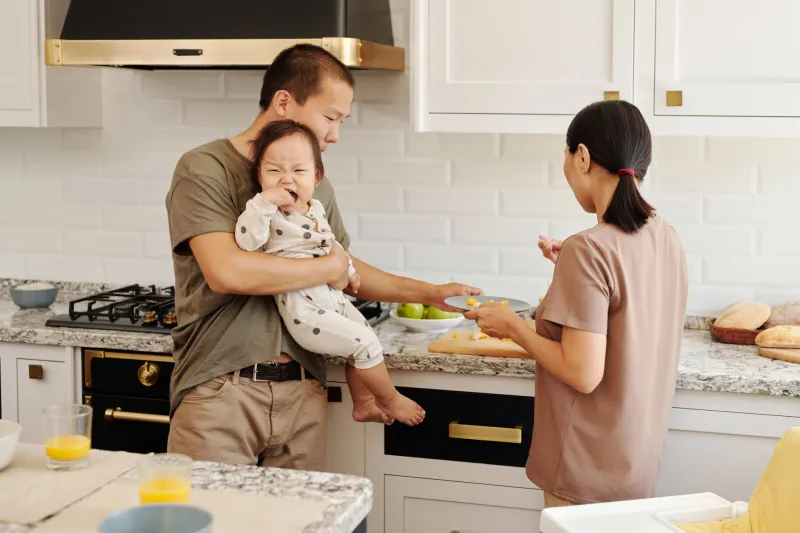
You don't need to redecorate to shift the energy in your kitchen. Sometimes it's as simple as pulling a chair up to the island and inviting your partner to sit with you while you cook. Or letting your kid pick a recipe and making it together without worrying about the mess until after dinner.
If you want to make some intentional design tweaks, consider adding a chalkboard wall or a simple whiteboard where anyone in the family can write down what they're craving or what's running low. It sounds small, but giving everyone a voice in the kitchen makes it feel like everyone's kitchen.
Swap out a few of those perfectly matched decorative elements for things that actually mean something — a ceramic bowl you picked up on a road trip, a plant your kid helped repot, a cookbook with actual stains in it. Meaning beats matching every time.
Your Kitchen Should Be the Easiest Room to Walk Into
At the end of the day, the kitchen is supposed to be the room where your family gravitates naturally — not because it looks like a set, but because it feels like the center of things. The smell of something good on the stove, the sound of chopping and conversation, the low-stakes chaos of everyone trying to help at once.
That's the kitchen worth designing toward. Not the one that photographs well, but the one that actually gathers people in. The most cozy corner of your home should also be the most forgiving one — and if your kitchen isn't that yet, it might be time to let it get a little messy.