Too Cozy to Think Big: What Your Comfort Zone Is Doing to Your Creativity

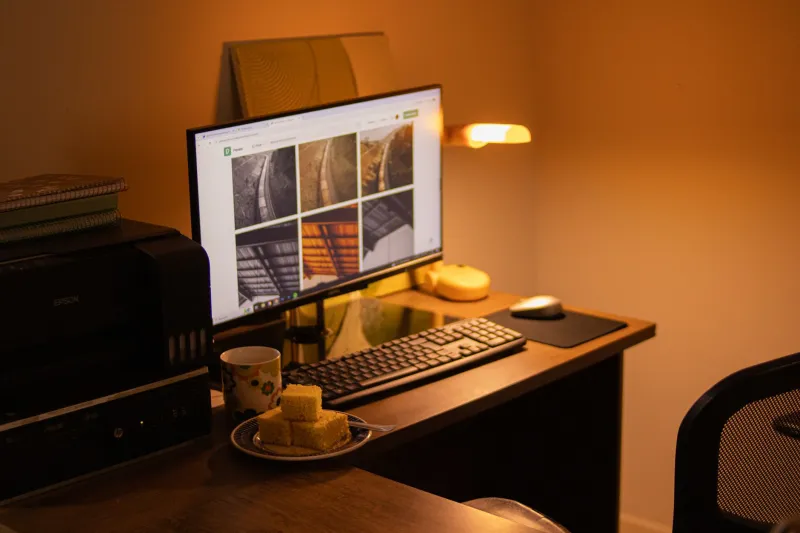
There's a particular kind of afternoon that feels almost perfect. The lamp is warm, the throw blanket is exactly the right weight, your favorite playlist is humming at just the right volume, and the cushions on your reading chair have finally broken in just the way you like. You sat down with every intention of brainstorming, journaling, or finally working through that project you've been putting off.
And then... nothing. Not writer's block, exactly. More like a pleasant, slightly foggy stillness where big ideas just can't seem to get any traction.
If that sounds familiar, you're not imagining it — and you're definitely not alone.
Your Brain on Comfort
Neuroscientists have a name for the mental state that maximum coziness tends to produce: low arousal. It's the opposite of the slightly edge-of-your-seat alertness that tends to fuel creative breakthroughs. Research published in the Journal of Environmental Psychology has consistently shown that our surroundings send constant signals to our nervous systems, and a space optimized entirely for relaxation is essentially whispering to your brain: stand down.
Dr. Arne Dietrich, a neuroscience researcher who has studied creative cognition, describes two broad modes of creative thinking. The first is the kind that happens during low-alert states — loose, associative, dream-like. The second is the focused, problem-solving variety that requires a brain that's genuinely switched on. Here's the tricky part: your perfect cozy room may be really good at producing the first type, while quietly smothering the second.
Soft, warm lighting (think: amber bulbs under 2700K) signals your body toward melatonin production and wind-down mode. Plush textures reduce sensory input that might otherwise keep your nervous system just alert enough to make connections. Even the scent of lavender, beloved in so many home wellness routines, has been shown in multiple studies to lower cognitive arousal. None of that is bad — it's beautiful, actually. But when you need to think creatively, it can work against you.
The Design Trap Nobody Talks About
Interior designers who work on home offices and creative studios often run into a version of this problem with clients. The ask usually goes something like: I want it to feel cozy and inspiring at the same time. And that's a completely reasonable thing to want. But the execution matters enormously.
The mistake most people make is treating comfort and stimulation as the same thing. They're not. Comfort is about reducing friction, lowering stress signals, and making your body feel safe and settled. Stimulation is about introducing just enough novelty, contrast, or cognitive challenge to keep your mind from going fully offline.
When a space is designed for pure comfort — warm tones throughout, minimal visual contrast, soft surfaces everywhere, low ambient light — it can become, in the words of environmental psychologist Sally Augustin, a space that "asks nothing of you." And a space that asks nothing of you tends to get nothing back.
What Stimulating Comfort Actually Looks Like
The good news is that you don't have to choose between a space that feels good and one that generates good thinking. You just have to be intentional about layering in what designers sometimes call productive friction — small design choices that keep your brain gently engaged without tipping into stress or distraction.
Play with contrast. One of the easiest ways to keep a cozy room from becoming cognitively flat is to introduce visual contrast. This doesn't mean going bold or loud. It can be as simple as pairing a warm-toned wall with cooler art, or mixing matte textures with one or two glossy surfaces. Contrast gives your eyes — and your brain — something to process, which keeps the cognitive engine idling a little higher.
Rethink your lighting layers. If you work or create in a space, consider a dual lighting setup. Keep your warm ambient lighting for the beginning and end of your sessions, but add a task light with a slightly cooler color temperature (around 4000K) that you can switch on when you actually need your brain firing on all cylinders. The shift itself can become a ritual that signals creative mode.
Bring in one thing that's slightly unexpected. Creative professionals often talk about keeping something in their workspace that they find genuinely interesting or slightly puzzling — an unusual object, a piece of art that makes them think, a plant they don't fully understand yet. Novelty is one of the brain's most reliable triggers for dopamine release, which is closely tied to motivation and idea generation.
Don't muffle the room completely. Acoustic softness — thick rugs, heavy drapes, upholstered furniture — is wonderful for reducing stress. But total silence or completely absorbed sound can actually feel deadening to creative thinking. Research from the University of Illinois found that a moderate level of ambient noise (around 70 decibels — think: a busy coffee shop) enhances creative output compared to both silence and loud noise. A light background soundscape with some variation can keep your brain just engaged enough.
Give yourself a visual anchor that's actually interesting. Staring at a blank, beautifully painted wall is restful. Staring at a bookshelf, a mood board, or even a window with a view gives your brain something to wander through during the mental pauses that often precede breakthroughs.
The Rhythm Approach
Some designers and psychologists suggest thinking about creative spaces in terms of rhythm rather than fixed design. The idea is that instead of trying to make one room do everything, you build a kind of intentional movement into your day — starting in your coziest, most restorative corner to decompress and let ideas float, then shifting physically or using design triggers (lighting, scent, even changing your seat) to move into a more activated state when it's time to actually develop those ideas.
This is actually very close to how a lot of writers, artists, and thinkers naturally work without realizing it. The cozy chair is where the idea arrives. The desk — maybe a little less comfortable, a little more lit — is where it gets built.
Making Peace with Productive Discomfort
None of this is an argument against coziness. At Cozy Cotg, we'd never make that case. The warmth, the softness, the feeling of a home that genuinely holds you — that matters deeply, and there's real science behind why restorative environments are good for your mental health, your relationships, and your overall quality of life.
But if you've been wondering why your most beautiful, carefully curated room keeps producing the same pleasant blankness every time you sit down to think — it might be worth asking whether you've accidentally designed yourself right out of your own best ideas.
The most creative spaces aren't the most comfortable. And the most comfortable spaces aren't always the most creative. But the ones that manage to do both? Those take a little more thought — which, fittingly, is exactly what they're designed to inspire.